
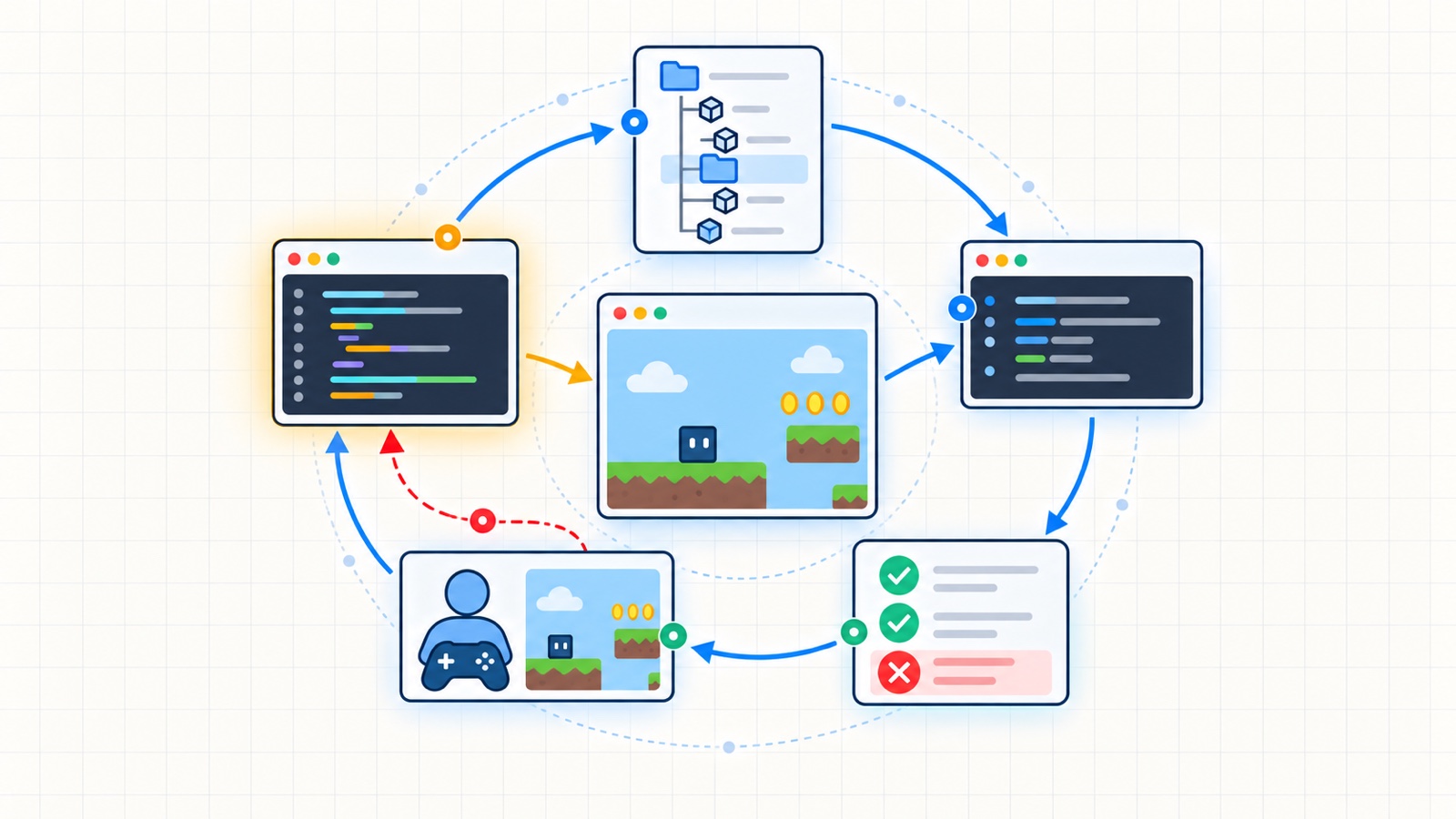
A coding agent can write GDScript quickly. That is not the same as building a playable prototype. A Godot change spans text files, scene resources, imported assets, editor behavior and feel that only appears while playing.
The safest useful workflow gives the agent a narrow vertical slice and makes the engine, tests and human play session the judges.
Updated
Commands were checked against the stable Godot command-line documentation. Engine flags and text-resource formats can change between releases; pin the project engine version.
Tested with
Godot stable command-line workflow · GitHub pull-request review model · coding-agent sandbox guidance
“Make a platformer” is not a task. A bounded slice might be:
Add a collectible key to the existing test room. When the player enters its area, increment
keys_collected, hide the key and emit one event. Reloading the room resets the count. Do not change player movement or project settings.
That brief identifies the allowed behavior, the forbidden behavior and the reset condition. Add exact files or directories when the repository has ownership boundaries.
Before delegating, create a clean checkpoint in version control and confirm the project opens. An agent should not inherit unexplained import errors and be asked to guess whether it caused them.
Put stable rules where the agent can find them:
- pinned Godot version and renderer;
- how scenes and scripts are organized;
- autoload names and signal conventions;
- commands for import, parse checks and tests;
- generated files it must not edit;
- asset-license and attribution rules;
- the acceptance criteria for the current task.
Keep this manual short enough to remain current. If a rule cannot be verified, it is probably guidance rather than a gate.
Key takeaway
The agent’s output is a patch plus evidence. “Implemented” means little until the engine can import the project, scripts parse, automated checks pass and a human can play the target interaction.
Godot provides command-line operations that fit an agent loop. A project can be imported headlessly, scripts can be parsed with --check-only in an appropriate invocation and exports can run without opening a window.
Project-specific commands might look like:
godot --headless --path . --import
godot --headless --path . --script res://tests/run_tests.gd
godot --headless --path . --export-debug "Linux" builds/game.x86_64
Do not copy these blindly. Record the commands that actually match your project, installed export templates and test harness.
- Reproduce the starting state and capture any existing warnings.
- Ask the agent to inspect relevant scenes, scripts and project instructions before proposing edits.
- Approve a file-level plan that stays inside the vertical slice.
- Let the agent implement one coherent change without unrelated cleanup.
- Run import, parser and targeted test commands.
- Inspect the diff for scene churn, project-setting changes and untracked generated files.
- Play the slice with a short checklist and record the result.
If the patch fails, feed the exact engine output back into the same task. Do not broaden the request to “fix everything.” A second failure with no new evidence is a reason to stop and inspect the model’s assumptions.
Godot scenes are text-friendly, but hand-editing them carries structural risk. Review:
- resource paths and unique identifiers;
- node ownership and parent relationships;
- signal connections;
- unexpected reserialization of an entire scene;
- changes to
.godot/or imported artifacts; - deletion of resources still referenced elsewhere.
Prefer a small script attached to an existing, clearly identified node over a sprawling scene rewrite. When the editor must create or migrate data, make that a declared step and review the resulting diff.
“Feels good” is useful feedback but poor acceptance criteria. Pair it with a thirty-second play script:
Start test room -> walk into key -> counter becomes 1
Walk through old key position -> counter remains 1
Reload room -> key returns and counter becomes 0
Disconnect controller -> keyboard controls still work
Capture a short video or screenshots for changes that are primarily visual. The artifact helps a reviewer understand the patch without reconstructing the entire environment.
Once one slice passes, the next task can add sound, animation or persistence. Keeping them separate makes regressions attributable and gives the agent less irrelevant context.
The goal is not to minimize human involvement. It is to spend human attention on architecture, feel and final judgment while the agent handles bounded implementation and repeatable checks.
- Godot command-line tutorial — headless mode, resource import, scripts and command-line export.
- Godot import process — how source assets enter the project and produce imported resources.
- GitHub pull requests — isolated changes, diffs, reviews and automated checks.
- OpenAI sandbox security — why agent access should be bounded by filesystem, credentials and network controls.