
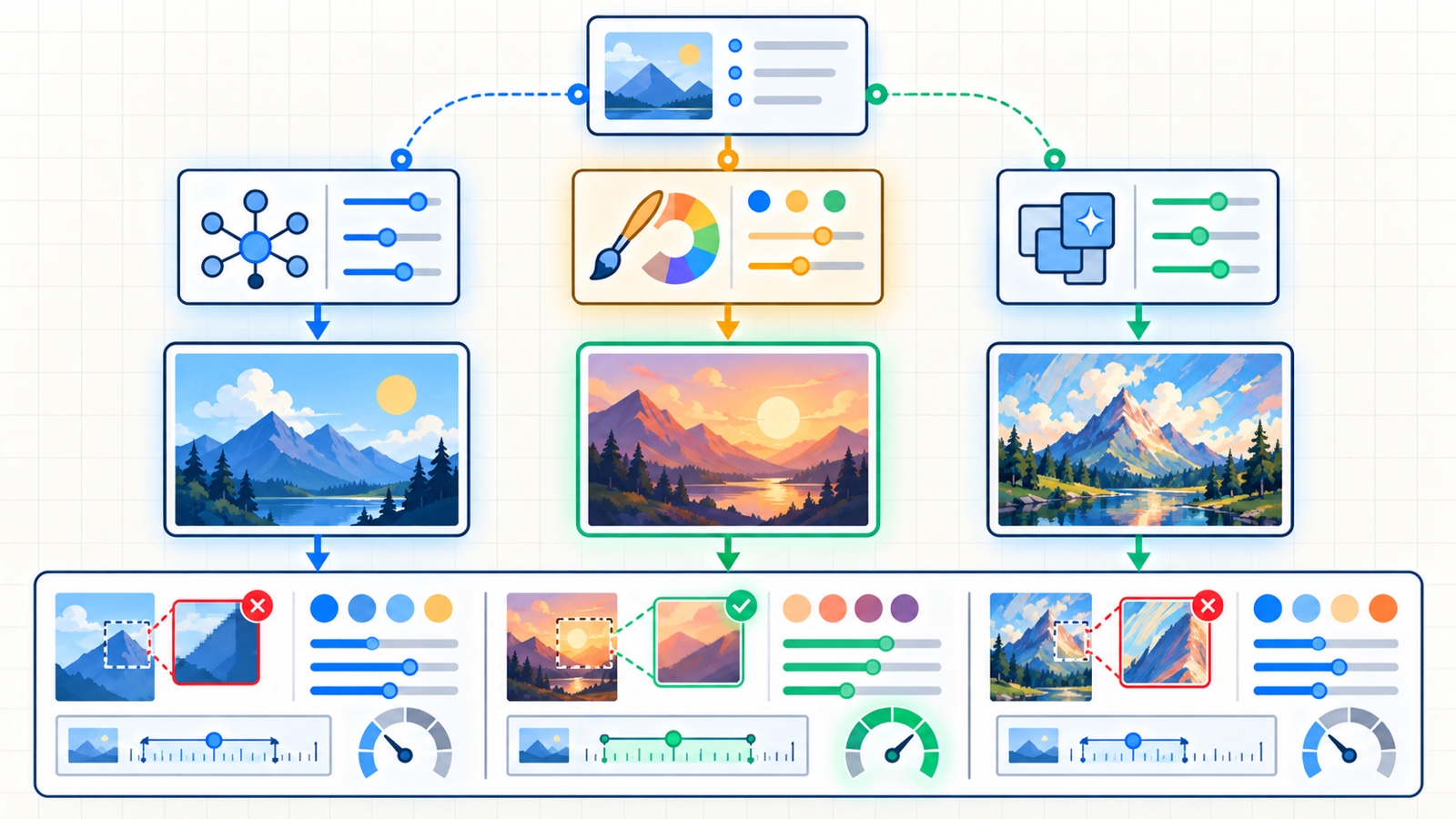
Most image-model comparisons are collections of attractive outputs. They are useful for inspiration, but weak as evidence: the prompts differ, the operator keeps only the best result and nobody records how much repair was needed.
A useful comparison starts with an editorial job, not a model leaderboard. The question is not “Which model makes the prettiest image?” It is “Which workflow can reliably deliver this asset under the same constraints?”
Updated
This protocol is provider-neutral. Product controls, prices, moderation rules and model availability change frequently; record them with every run.
Tested with
OpenAI image-generation guidance · OpenAI evaluation guidance · C2PA 2.x
Use a brief that resembles work you would actually publish. For a technical article hero, that might be:
- a 16:9 editorial diagram showing a request moving through retrieval, ranking and answer generation;
- a light neutral background with one restrained blue accent;
- no logos, faces or decorative text;
- enough empty space for a headline crop;
- legible at 640 pixels wide;
- no copyrighted character or living artist imitation.
Freeze the brief before opening any generator. If the brief changes after seeing an output, you are evaluating your ability to move the goalposts.
Key takeaway
Compare complete workflows against a fixed acceptance test. A strong first image that cannot be edited, reproduced or safely published may be less useful than a weaker draft with a controllable repair loop.
Create one canonical prompt from the brief, then define a small change budget. Each tool receives the same base prompt and the same number of attempts. Record any provider-specific adaptation instead of hiding it.
The run sheet should capture:
| Field | Why it matters |
|---|---|
| Tool and model identifier | “The image tool” is not a reproducible version |
| Date and account tier | Availability and defaults may differ |
| Prompt and negative constraints | Lets another person inspect the input |
| Size, quality and seed controls | Explains output and cost differences |
| Attempts used | Prevents unlimited cherry-picking |
| Generation and edit time | Measures the whole workflow |
| Manual repair notes | Reveals work displaced into an editor |
| Export format and metadata | Affects delivery and provenance |
Do not force identical settings that mean different things across products. Instead, hold the editorial constraint constant and disclose how each product was configured to meet it.
Use a rubric with anchored descriptions rather than a vague score from one to ten.
- Brief adherence: Are every required object, relationship and exclusion present?
- Composition: Does the focal hierarchy survive the intended crop?
- Text and symbols: Are labels, arrows and interface-like elements accurate?
- Consistency: Can a selected direction survive two controlled edits?
- Repairability: Can the operator change one region without rebuilding the frame?
- Publishability: Are rights, disclosure, provenance and export requirements satisfied?
- Efficiency: How many attempts, minutes and paid units were consumed?
Score blind when practical. Rename outputs, remove provider metadata from the review copy and ask two reviewers to use the same rubric. Keep the original files untouched for provenance inspection.
- Freeze one real brief, its output dimensions and five to seven acceptance criteria.
- Create a run sheet and decide the attempt limit before generating anything.
- Run the same base prompt through each workflow and retain every output.
- Select one candidate per workflow using the rubric, not taste alone.
- Apply the same two edit requests, such as moving the focal object and removing a label.
- Export the final candidate and inspect dimensions, file size and available provenance metadata.
- Publish the rubric, run sheet and representative failures with the conclusion.
A small comparison cannot establish that one model is universally best. It can establish that, on a dated tool version and a defined brief, one workflow required fewer retries or produced a more editable result.
Keep model quality separate from product quality. The application may add masking, history, asset management or export controls that materially change the result. Conversely, a powerful model behind a thin interface may be a poor fit for a team workflow.
The final report should include at least one failure from every tool. Failure cases explain the operating boundary and are more reusable than a gallery of winners.
Warning
Do not remove or rewrite provenance metadata in the evaluation originals. Content Credentials can carry signed provenance, but their absence does not prove that an asset is human-made and their presence does not replace editorial review.
Choose by workload:
- use a fast, simple interface for disposable ideation;
- use an editable workflow when art direction will change;
- use a local or controlled pipeline when model, data or dependency provenance matters;
- require an explicit human approval step for anything representing a real person, brand or event.
That recommendation is less exciting than a single winner. It is also more likely to survive the next model release.
- OpenAI image generation guide — current generation and editing controls, output formats and documented limitations.
- OpenAI evaluation best practices — task-specific datasets, explicit metrics, human calibration and continuous evaluation.
- C2PA specifications — the open technical standard and guidance for content provenance.