VoiceStudio is the open-source, fully-local ElevenLabs alternative — voice cloning, voice design, video dubbing, dictation, transcription & audiobook creation in 646 languages.
My analysis
VoiceStudio: Inside a Local-First Speech Production Stack
A source-level analysis of VoiceStudio's architecture, OmniVoice engine, APIs, security model, licensing and operational trade-offs.
TN
TIAN NEWS AI
Published · Updated · 16 min read
Voice cloning demos are easy to misunderstand. A short recording goes in, synthetic speech comes out, and the model appears to be the whole product. In a production system, however, the model is only one stage in a much larger chain: audio capture, voice identity, model loading, text normalization, synthesis, post-processing, project state, export, access control and failure recovery all matter.
VoiceStudio is interesting because it treats that chain as the product. It combines a desktop application, a local API, multiple speech engines, transcription, dubbing, audiobook tooling, automation interfaces and optional remote compute. Its default text-to-speech path is built around OmniVoice, a multilingual non-autoregressive model, but the application is deliberately broader than any single model.
This article is a source-level research review of that system. It examines the main branch at commit 28801c8, application version 0.5.7, and the latest stable release available during the review, v0.5.6. The analysis covers architecture and documented behavior; it does not present an independent listening test or hardware benchmark.
Updated
Repository structure, APIs, security behavior, engine documentation, release state and licensing were checked on October 5, 2026. VoiceStudio changes quickly; pin a release or commit before integrating it.
Tested with
VoiceStudio main at 28801c8 · app 0.5.7 · stable release v0.5.6 · OmniVoice paper arXiv:2604.00688
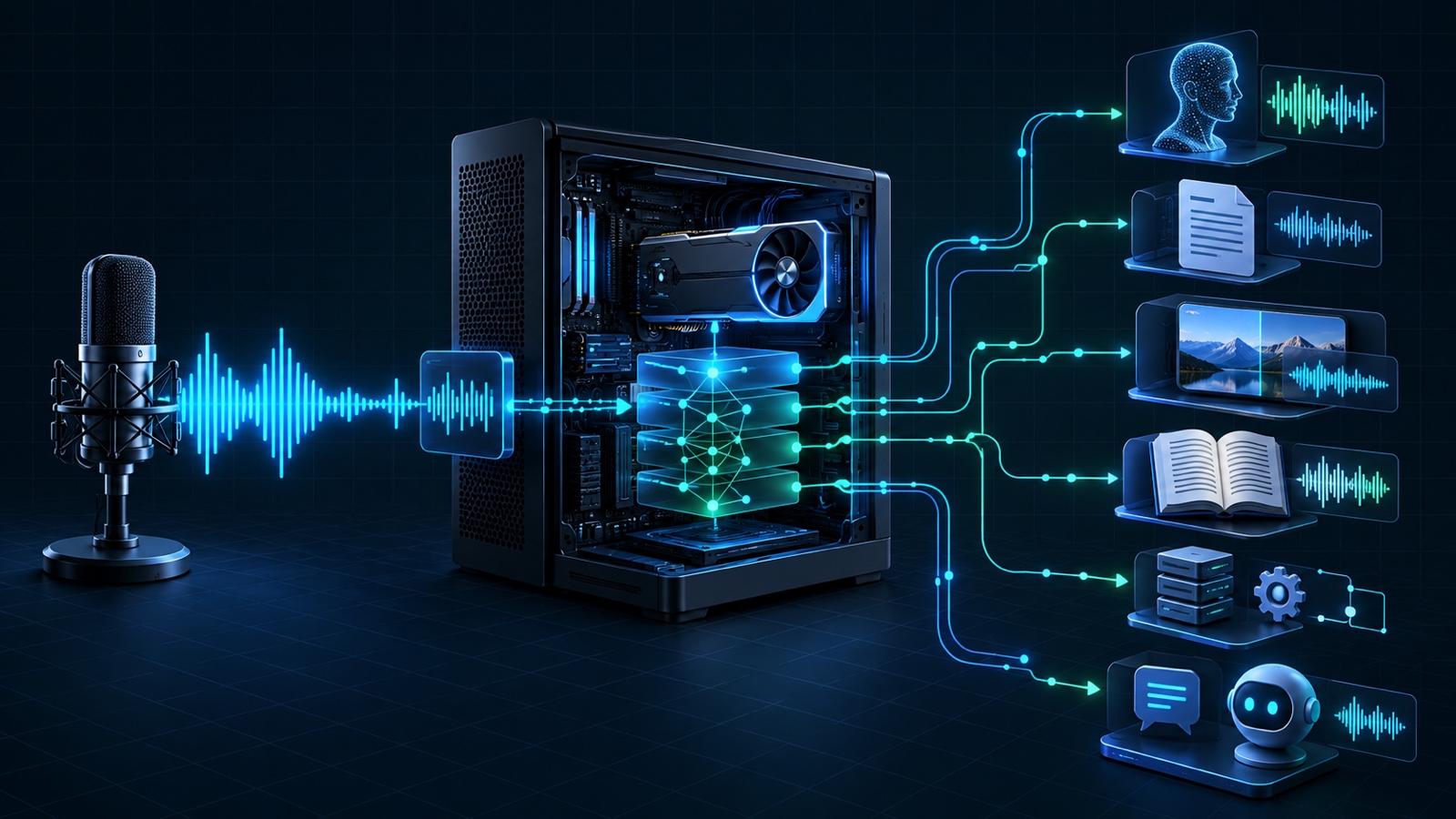
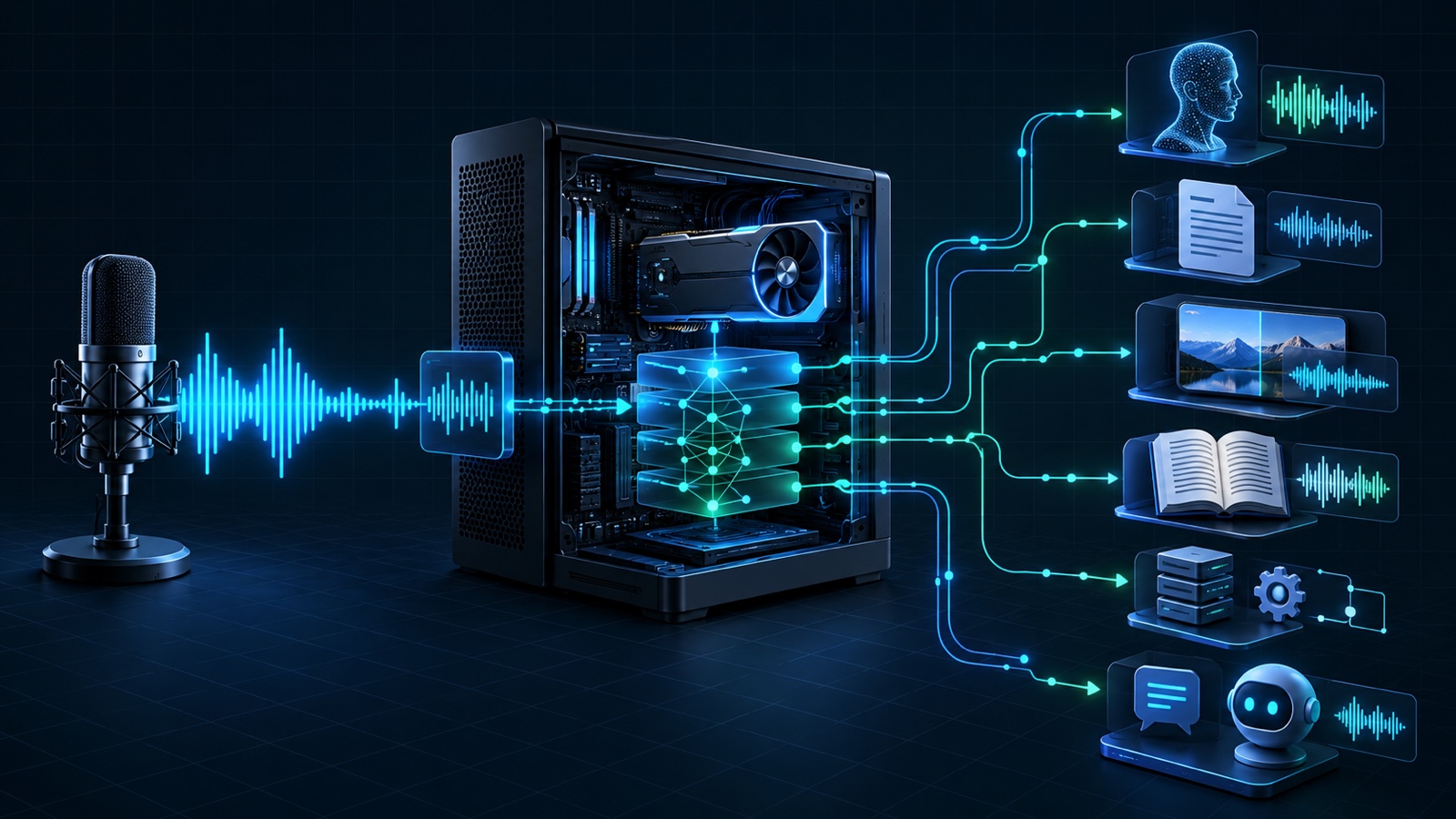
VoiceStudio places local compute at the center of a speech pipeline serving creative workflows, APIs and agents.
What VoiceStudio is
VoiceStudio describes itself as a fully local alternative to hosted speech platforms. That description is directionally useful, but “local ElevenLabs alternative” hides the most consequential engineering choice: VoiceStudio is not merely a voice-cloning model with a user interface. It is a speech production and serving environment.
The current product surface includes:
zero-shot voice cloning from reference audio;
prompt-based voice design with reusable voice profiles;
multilingual text-to-speech and speech-to-text;
live dictation with partial and final transcripts;
video dubbing, translation and segment-level synthesis;
long-form story and audiobook generation;
batch workflows, effects, mastering and export history;
an OpenAI-compatible HTTP API and streaming WebSocket protocol;
an MCP server for agent access;
optional remote GPU workers and remote backend connections.
A local-first speech production platform for voice cloning, design, dubbing, transcription, dictation and audiobook workflows
VoiceStudio is the open-source, fully-local ElevenLabs alternative — voice cloning, voice design, video dubbing, dictation, transcription & audiobook creation in 646 languages.
Python
ai
audiobook
113.4k113,388 stars12.6k12,599 forksSnapshot Nov 18, 2026
This breadth changes the evaluation question. The relevant question is not simply “Does one generated sentence sound natural?” It is “Can the system move a speech project from input to a reproducible output while preserving identity, timing, metadata, security and recoverability?”
Key takeaway
VoiceStudio's primary architectural contribution is integration. It places heterogeneous speech models behind one local control plane and connects them to practical authoring, serving and automation workflows.
Local-first is a deployment property, not a magical guarantee
The application can keep inference, project data and voice assets on hardware controlled by the operator. That is materially different from uploading every prompt and reference recording to a hosted provider. It can improve privacy, latency predictability, offline resilience and cost control.
But local-first does not mean that every action is offline or that no data can leave the machine. Models may need to be downloaded. Optional analytics, remote backends, network sharing and remote workers introduce network paths. A user can also configure external engines or services. The precise privacy boundary is therefore the deployed configuration, not the word “local” on the product page.
The safer interpretation is local ownership by default, with explicit opt-in network paths.
That is a useful systems principle because it can be audited. One can identify which component owns the microphone, where a voice reference is stored, which process performs inference and which settings enable remote transport.
Architecture
The repository is a monorepo with three important product layers: an Electron and React desktop client, a Python FastAPI backend, and a collection of engine adapters and model packages. A Rust desktop helper handles native integration where Electron alone is not sufficient.
Diagram — its source is below.
Diagram source
flowchart LR
  A[Electron and React UI] --> B[FastAPI backend on port 3900]
  C[OpenAI SDK or HTTP client] --> B
  D[WebSocket microphone client] --> B
  E[MCP agent client] --> B
  B --> F[Application services and job queue]
  F --> G[TTS engine registry]
  F --> H[ASR and diarization engines]
  F --> I[Dubbing and long-form pipelines]
  G --> J[CUDA, ROCm, MPS or CPU]
  H --> J
  I --> J
  F --> K[(SQLite metadata and local media)]
  F -. opt-in job dispatch .-> L[Remote GPU worker]
The desktop shell is not the inference runtime
Electron owns the native application lifecycle, backend supervision, runtime setup, updates and desktop IPC. React renders the working interface. The backend owns model lifecycle, job execution, media processing, persistence and the network protocols used by other clients.
This boundary is important for two reasons. First, the desktop UI can be replaced by a script, editor extension or web client without reimplementing model loading. Second, a long-running model process can remain warm while interfaces connect and disconnect. Speech applications pay significant cold-start costs, so keeping the data plane alive is not just architectural neatness; it is a latency feature.
The repository structure makes the separation visible. Thin HTTP and WebSocket routers live under backend/api/routers, business logic lives under backend/services, engine-specific code lives under backend/engines, and the Electron application has distinct main, preload, renderer and shared layers.
FastAPI acts as the local control plane
The backend listens on port 3900 by default. It exposes health and discovery information, conventional request-response endpoints, live transcription streams and the mounted MCP server. The desktop app is therefore one privileged client of a general local speech service rather than the only possible interface.
This service boundary also creates a clean place to enforce cross-cutting policy:
authentication for non-loopback clients;
CSRF protection for cookie-authenticated mutations;
model and engine selection;
queueing and timeout budgets;
path confinement for agent-provided files;
project, history and voice-profile persistence;
remote-worker scheduling and recovery.
The trade-off is operational complexity. A user-visible desktop application now includes a supervised Python service, database migrations, model caches, media files and GPU-specific dependencies. Packaging must keep those pieces compatible across macOS, Windows and Linux.
Engine adapters prevent the UI from becoming model-specific
VoiceStudio's backend does not hard-code one TTS implementation into every workflow. Engine adapters expose different models through a common service layer. The current catalogue includes OmniVoice variants, VoxCPM2, MOSS-TTS-Nano, KittenTTS, the MLX-Audio model family, CosyVoice 3, GPT-SoVITS, Sherpa-ONNX, IndexTTS, Supertonic and other engines, alongside multiple ASR options.
This abstraction is more consequential than the number of engines in the catalogue. Speech models disagree about reference-audio formats, language controls, streaming behavior, speaker representations, device support and output cleanup. The adapter layer gives higher-level workflows a stable vocabulary while preserving engine-specific capability checks.
A good abstraction here must avoid the “lowest common denominator” trap. If every engine is reduced to text -> wav, the system loses voice design, timestamps, style control and streaming. VoiceStudio addresses this by exposing shared operations while retaining capability metadata and engine-specific settings. The application can then disable unsupported controls instead of silently ignoring them.
Jobs are a better unit than direct model calls
Interactive speech generation can still take seconds or minutes, and long-form work may contain hundreds of segments. VoiceStudio therefore treats expensive operations as jobs with queueing, progress and failure states. This is especially important for dubbing and audiobooks, where partial completion should be recoverable.
The remote-worker design extends the same job boundary. A worker reports installed engines and available capacity; the scheduler sends only compatible tasks. Enrollment is opt-in, uses short-lived join material and creates a durable worker identity. Outbound worker connections use TLS, and the control plane can approve, pause, prefer or revoke a worker.
Not every operation is remote-capable. The documentation explicitly keeps dictation local because latency dominates that experience. Current remote execution focuses on speech synthesis, audiobook chapters and dub-segment synthesis, while final fitting and assembly remain local. This selective boundary is more credible than a claim that every workflow distributes transparently.
Code analysis
OmniVoice changes the generation pattern
The default model family is k2-fsa/OmniVoice. The associated paper describes a discrete non-autoregressive diffusion language model trained on approximately 581,000 hours of speech spanning more than 600 languages.
Autoregressive speech models usually predict the next acoustic token conditioned on all previous tokens. If an utterance contains T token positions, inference has a sequential dependency chain roughly proportional to T: the probability of the complete acoustic sequence is decomposed into successive next-token probabilities conditioned on the text and earlier acoustic tokens.
OmniVoice instead begins with a masked acoustic grid, applies a bounded sequence of denoising steps and resolves the final audio tokens. Positions can be predicted in parallel within each step.
This changes where latency comes from. Runtime depends more on a fixed or bounded number of refinement steps than on generating every acoustic token one by one. It also creates a quality-speed control: fewer denoising steps can reduce latency, while more steps may improve reconstruction.
The model generates multi-codebook acoustic tokens directly from text rather than producing an intermediate semantic-token stream first. The paper argues that full-codebook random masking and initialization from a pretrained language model help scale this direct mapping across a very large language set.
That model architecture and the VoiceStudio application should not be conflated. OmniVoice determines one synthesis path. VoiceStudio determines how references are captured, profiles are stored, jobs are scheduled, audio is post-processed, projects are resumed and clients access the result.
“646 languages” requires careful interpretation
The repository advertises 646 languages. This is best understood as the size of the exposed language inventory, not a guarantee of equal quality, speaker similarity or pronunciation accuracy across all 646.
Multilingual performance depends on at least four distributions:
the quantity and quality of training speech for a language;
the writing system and text normalization path;
the match between reference speaker, target language and requested style;
the evaluation set and the speech recognizer used to measure errors.
The OmniVoice paper reports results on the 102-language FLEURS benchmark. Its aggregate table reports an average objective speaker-similarity score of 0.788 and average character error rate of 4.00. It reports 82 languages at or below 5% CER and 95 at or below 10% CER. Those are strong coverage results, but they still describe a benchmark subset, a particular model and a particular evaluation pipeline.
Character error rate equals substitutions, deletions and insertions divided by the number of reference characters.
CER measures whether an automatic recognizer recovers the expected text. It does not directly measure naturalness, emotional appropriateness, accent authenticity or whether a listener would accept the voice as the target speaker. Speaker-similarity metrics add another view, but listening studies remain necessary for perceptual quality.
Paper speed is not application speed
The paper reports a real-time factor of 0.0319 for batch size one on an NVIDIA H20 at 16 diffusion steps, and 0.0224 at batch size eight. Real-time factor is synthesis time divided by generated audio duration.
An RTF below one means synthesis is faster than playback. These numbers describe a controlled model benchmark on high-end hardware. They do not include every application cost: model download, cold start, text chunking, resampling, voice-profile preparation, effects, file encoding, IPC, queue wait or remote transfer.
VoiceStudio handles this distinction responsibly in its own benchmark document. The in-repository application benchmark table currently has no verified rows. It provides a harness and contribution format instead of copying model-paper numbers into an application-performance leaderboard.
Keep the benchmark layers separate
Model-paper throughput answers how fast one model ran under a documented setup. VoiceStudio end-to-end latency answers how long a user waits on a particular machine and workflow. One number cannot substitute for the other.
The OpenAI-compatible API is a practical interoperability layer
VoiceStudio exposes familiar endpoints including POST /v1/audio/speech and POST /v1/audio/transcriptions. Existing clients can point an OpenAI SDK at the local base URL rather than adopting a new transport immediately.
local_speech.py, python
from openai import OpenAIclient = OpenAI( base_url="http://127.0.0.1:3900/v1", api_key="local",)audio = client.audio.speech.create( model="tts-1", voice="alloy", input="A local speech service can still expose a familiar API.", response_format="wav",)audio.write_to_file("speech.wav")
On loopback, no credential is required by default, so the SDK accepts an arbitrary placeholder key. On a remote deployment, the configured OMNIVOICE_API_KEY must be supplied as a bearer credential and the connection should use TLS or an encrypted overlay network.
Compatibility is intentionally bounded. An OpenAI-shaped endpoint does not make every local engine behave exactly like a hosted model. Voice lists, model installation, cloning, language controls and long-running jobs still require VoiceStudio-specific capability discovery or APIs.
Streaming transcription is a distinct protocol
Live transcription uses a WebSocket at /v1/audio/transcriptions/stream. A client can send WebM/Opus frames or signed 16-bit mono PCM, then finish the input with an input_audio.end message. Responses distinguish session start, partial hypotheses and final text.
That protocol reflects a useful architectural boundary: the microphone remains at the interface edge. An editor extension can own capture while the Python backend keeps the recognizer warm. A remote GPU service therefore does not need permission to activate the user's microphone.
MCP turns speech into an agent capability
The mounted MCP endpoint at /mcp/ exposes tools such as generate_speech, clone_voice, design_voice, transcribe, list_voices and check_health. This lets an agent create or inspect speech without shelling out to an undocumented command.
The design includes two details that matter for real agent systems.
First, output modes can return files or URLs instead of placing base64-encoded WAV data into the model context. That avoids paying context cost for binary data the model cannot reason about usefully.
Second, path-based inputs are disabled unless OMNIVOICE_MCP_BASE_PATH is configured. Paths are resolved and confined to that base, including symlink checks. The base directory is therefore a security boundary, not a convenience setting.
Per-agent client identifiers can be bound to different saved voices. That is a small feature with a larger implication: voice becomes part of agent identity configuration rather than an ad hoc parameter repeated in every prompt.
The security model is local by default and explicit when shared
The backend is loopback-only and unauthenticated by default. This is a reasonable desktop default: local scripts work without provisioning secrets, while the operating-system account remains the primary boundary.
Once the backend is reachable from another device, VoiceStudio offers separate controls:
a six-digit share PIN for temporary non-loopback HTTP consumption;
a durable API key for direct HTTP and WebSocket clients;
short-lived administrator sessions for the first-party UI;
CSRF and exact-origin checks for cookie-authenticated mutations;
trusted-network exemptions for deliberately approved networks;
stricter protection for administration and host-path capabilities.
The distinction between consumption and administration is valuable. A PIN that permits playback or synthesis should not unlock settings that can execute commands, manage workers or access arbitrary host paths. The documentation also correctly warns that credentials sent over plain HTTP can be observed; authentication does not provide transport encryption.
Treat cloned voices as sensitive identity data
A voice reference can be personally identifying and can enable impersonation. Obtain consent, restrict access to profiles and source recordings, and keep generated media traceable to its project and operator.
My experience
For this review, I inspected the repository structure, API and security documentation, engine catalogue, benchmark policy, release metadata, license notice and OmniVoice research artifacts. I did not install the multi-gigabyte default model or conduct a controlled listening study. The conclusions below separate what the source demonstrates from what still needs empirical verification.
What the project does well
The strongest part of VoiceStudio is boundary design. The React client does not own inference. Routers are separated from services. Engines sit behind adapters. Expensive work is modeled as jobs. Remote workers are optional and capability-aware. Agent file access is confined. Loopback ergonomics and remote authentication are treated as different operating modes.
The documentation is unusually candid in several places. It distinguishes native dictation from external capture, marks remote execution as partial, documents which operations remain local and leaves the application benchmark table empty until measurements are reproducible. Those choices make the system easier to evaluate than a feature list alone.
The breadth is also genuinely useful. A creator can clone or design a voice, generate short samples, assemble long-form material, dub video, transcribe recordings and expose the same backend to tools. Consolidating those workflows can reduce the format conversion and metadata loss that occur when each stage belongs to a separate application.
What still needs verification on the target machine
Speech quality is hardware-, language- and input-dependent. Before adopting VoiceStudio for a production workflow, I would run a compact acceptance suite using the exact release, engine and device intended for deployment:
Record clean and noisy reference clips from speakers who have explicitly consented.
Test short, long, numerical and punctuation-heavy text in every required language.
Measure cold start, warm RTF, peak memory and failure recovery on the target device.
Compare speaker identity and intelligibility with both objective metrics and blinded listening.
Exercise interruption, retry and resume behavior on audiobook and dubbing jobs.
Verify that remote sharing rejects unauthenticated HTTP, WebSocket and administration requests.
Export the final audio and confirm loudness, clipping, timestamps and project provenance.
The repository's own benchmark harness is the right starting point for performance because it unloads models between stages and records device, engine, app version, warm RTF and peak VRAM where measurable. Quality evaluation needs a separate protocol; throughput cannot stand in for naturalness.
Licensing is a three-layer decision
The application code is licensed under AGPL-3.0-only. The project's license notice says ordinary internal and commercial use is permitted, while organizations embedding a modified network-accessible version in a closed-source product need to understand the Affero source-offer obligations or obtain a separate commercial license.
The bundled OmniVoice source package is separately licensed under Apache 2.0. The default pretrained model weights are identified as CC-BY-NC, and the audio tokenizer carries additional upstream terms. These layers are independent:
Layer
Stated terms
Practical question
VoiceStudio application
AGPL-3.0-only
Are modifications offered to users over a network?
OmniVoice source code
Apache-2.0
Are notices and license conditions preserved?
Default weights and tokenizer
CC-BY-NC plus separate upstream terms
Is the intended use commercial, and do all model terms permit it?
Buying or receiving permission for one layer does not automatically change the others. Teams should record the exact engine, model revision and asset licenses used for every exported production workflow.
Operational rough edges are part of the decision
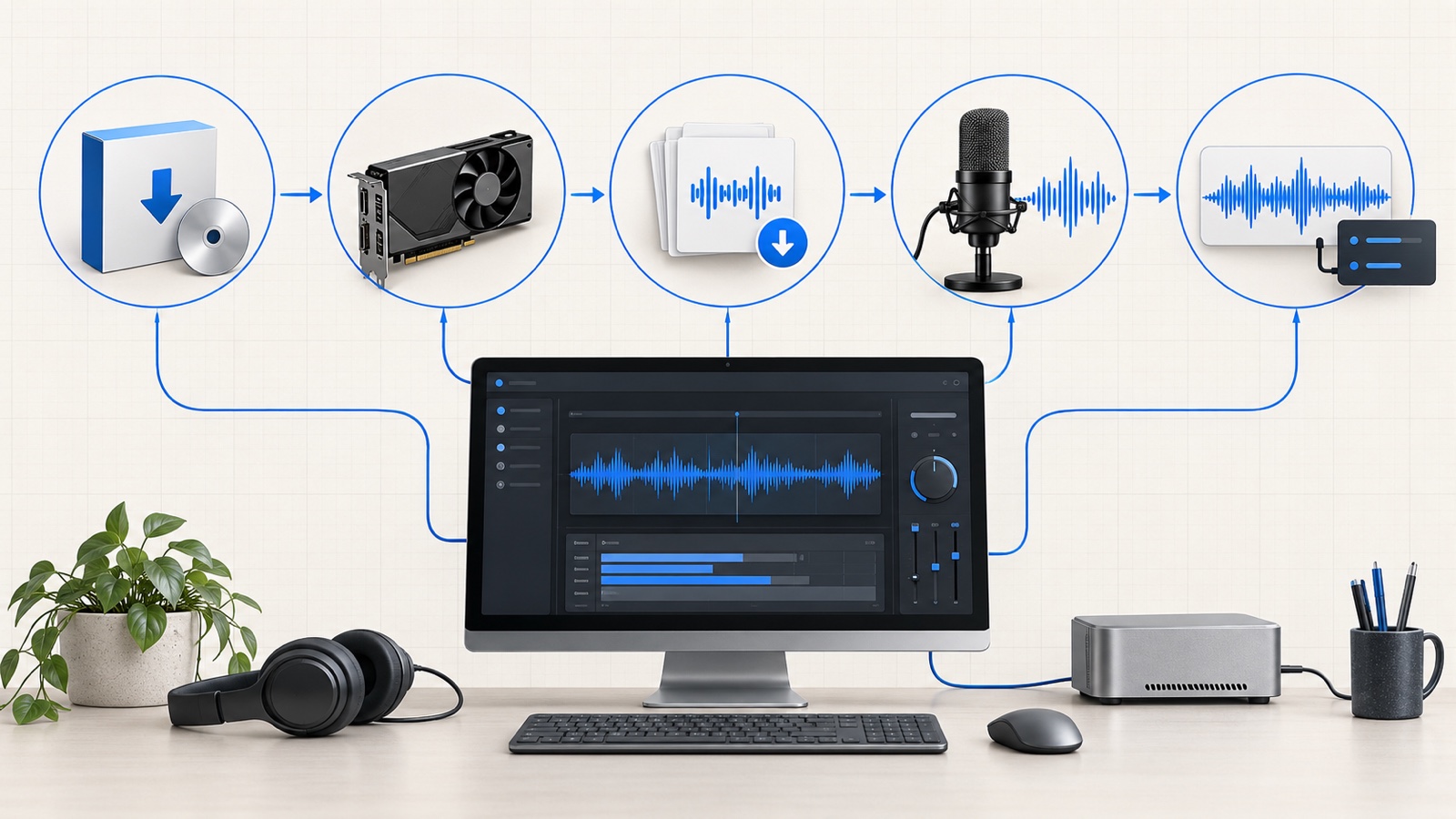
Local inference moves cost and responsibility from a vendor account to the operator. The first generation may download roughly 2.3 GB for the default model. GPU drivers, Python dependencies, ffmpeg availability, disk space and model caches become part of support. Different engines have different device compatibility.
The latest stable desktop release during this review is v0.5.6, while the main branch reports 0.5.7. Release binaries are described as unsigned or ad-hoc signed, and macOS packages are not notarized. That is manageable for technically confident users, but it is a meaningful deployment constraint for managed fleets and less technical teams.
The repository is also moving quickly. Its breadth increases regression risk because changes can cross Electron packaging, Python services, model adapters, native helpers and GPU-specific runtime paths. Pinning a release, preserving project backups and testing upgrades against representative jobs are essential.
Where VoiceStudio fits
VoiceStudio is a strong candidate when the operator values local control, is comfortable managing model dependencies and needs more than a single TTS endpoint. It is particularly compelling for researchers, indie creators, accessibility tooling, privacy-sensitive transcription, local agent experiments and teams building repeatable dubbing or audiobook pipelines.
It is a weaker fit when the primary requirement is a managed SLA, globally elastic throughput, turnkey enterprise identity, zero local installation or contractual commercial rights to every bundled model asset. A hosted speech API remains simpler when operations matter more than data locality and customization.
The comparison with ElevenLabs should therefore be framed as a deployment and workflow trade-off, not a universal quality ranking:
Dimension
VoiceStudio
Managed speech platform
Data path
Local by default, configurable remote paths
Provider-controlled cloud path
Cost model
Hardware, electricity and operator time
Usage-based service pricing
Customization
Source, engines and workflows are inspectable
Product and API controls only
Operations
User manages models, drivers and upgrades
Provider manages infrastructure
Scaling
Local devices and opt-in workers
Elastic provider capacity
Licensing
Application and model terms must be checked separately
Commercial service terms govern use
Resources
VoiceStudio is best understood as infrastructure for speech work rather than a wrapper around one impressive model. Its Electron/FastAPI split, engine registry, job-oriented services, OpenAI-compatible surface, MCP tools and worker protocol form a coherent platform around local inference.
The architecture does not eliminate hard problems. Quality still varies by language and reference material. Local deployment still has supply-chain, packaging and GPU complexity. Remote access still requires encrypted transport and disciplined credentials. Model licenses still constrain use independently of the application's open-source license.
That balance is precisely why the project is worth studying. It shows what must exist between a research model and a usable creative system—and it documents enough of those boundaries for an engineer to test rather than merely trust them.
VoiceStudio repository — product overview, source tree, installation paths and release history.