
langgraph
langchain-ai/langgraph
A graph runtime for durable, stateful agent workflows with explicit control over steps and recovery
Build resilient agents.
- Python
- agents
- ai
45,117 stars7,786 forksSnapshot Nov 18, 2026
langchain-ai/langgraph
A graph runtime for durable, stateful agent workflows with explicit control over steps and recovery
45,117 stars7,786 forks
Build resilient agents.
My analysis
Understanding LangGraph Architecture
A source-oriented tour of LangGraph state, nodes, supersteps, checkpoints and interrupts, with guidance on where the runtime fits.
TIAN NEWS AI
Published Updated 4 min read
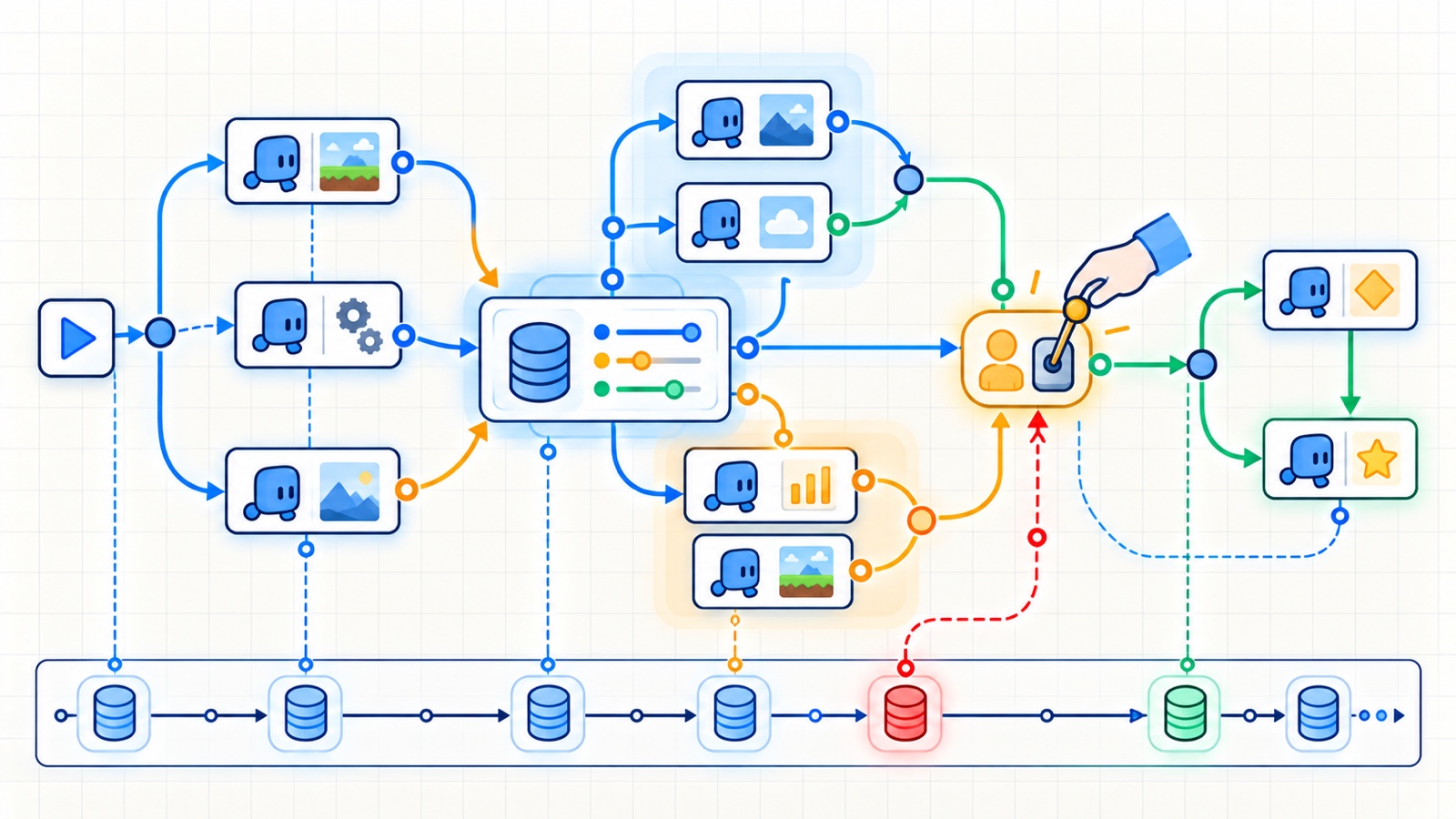
LangGraph is easiest to understand as a stateful graph runtime, not as a magic agent loop. The application defines state, computation nodes and routing. The runtime schedules work, merges state updates and can persist checkpoints around each step.
That distinction matters when the workflow must pause for approval, recover after failure or inspect how a result was produced.
Updated
Describes the public LangGraph concepts and repository documentation available on October 2, 2026. Pin a package release or commit before source-level implementation work.
Tested with
langchain-ai/langgraph · LangGraph overview · persistence · durable execution
langchain-ai/langgraph
A graph runtime for durable, stateful agent workflows with explicit control over steps and recovery
Build resilient agents.
45,117 stars7,786 forksSnapshot Nov 18, 2026
A graph begins with a state schema. Nodes receive the current state and return updates. Edges determine which node or set of nodes runs next.
Conceptually:
class State(TypedDict):
    messages: Annotated[list, add_messages]
    approved: bool

builder = StateGraph(State)
builder.add_node("draft", draft_reply)
builder.add_node("review", review_reply)
builder.add_edge(START, "draft")
builder.add_conditional_edges("draft", route_after_draft)
graph = builder.compile(checkpointer=checkpointer)
The important detail is that node returns are state updates. Reducers define how parallel or repeated updates combine. Without an explicit reducer, an update may replace a field rather than append to it.
The builder describes topology. Compilation validates and turns it into a runnable graph where runtime concerns can be attached: checkpointing, interrupts and stores.
Keep business rules in nodes and routing functions that can be tested without a live model. Put provider clients, databases and queues behind application boundaries. A graph definition should not become a place where every integration imports every other integration.
Key takeaway
LangGraph makes control flow explicit, but it does not make side effects safe. A retried node can repeat an email, charge or database write unless that operation is idempotent or separately committed.
LangGraph’s execution model follows graph-processing ideas: nodes made active by the current state can execute within a step, and their updates become visible at the step boundary. This enables fan-out and fan-in patterns without pretending the graph is a simple line.
When two nodes update the same state key, the schema’s reducer is the concurrency contract. If the order of results matters, encode ordering data rather than relying on completion timing.
Typical topology:
START -> classify -> research_a --\
                    research_b ----> synthesize -> END
                    research_c --/
The graph shows control dependencies. It does not automatically impose a distributed transaction across those nodes.
With a checkpointer, LangGraph persists graph state as checkpoints associated with a thread identifier. Checkpoints support inspection, replay, fault recovery and human-in-the-loop pauses.
Use a durable checkpointer for production. An in-memory saver is appropriate for tests and local experiments, not recovery after a process restart.
Separate thread-scoped checkpoints from cross-thread memory. A conversation’s execution state and a user profile have different lifetimes, access rules and deletion requirements. LangGraph exposes stores for data that must outlive or cross thread boundaries; the application still owns the data model and policy.
Recovery may resume from a recorded step rather than from the exact machine instruction that failed. Design nodes so that replay is safe:
If a node both calls a model and sends an email, recovery becomes ambiguous. Split proposal, approval and delivery into distinct nodes.
An interrupt pauses execution and surfaces a payload to the caller. The application records the thread and later resumes it with a decision.
This is stronger than a chat message saying “please approve.” The pause exists in runtime state and can survive the request that created it.
Approval still needs application security: authenticate the reviewer, authorize the action, bind the decision to the exact proposed payload and audit who resumed the thread. The graph runtime does not know your organization’s approval policy.
LangGraph is a good fit when the application needs explicit branching, cycles, persistence and recovery. A plain function or queue worker is often clearer for a short, deterministic pipeline. A durable workflow engine may be more appropriate when cross-service transactions and operational scheduling dominate the problem.
The architecture earns its complexity when the graph itself is a useful model of the product’s control flow.